How to Make Edibles at Home: A Simple Beginner’s Guide (Gummies, Brownies & More)
Making your own edibles sounds a little intimidating the first time. Do you just throw some flower into the brownie batter? (Please don’t.) The good news: once you understand two simple steps, you can turn almost any recipe into an edible, from brownies and cookies to gummies and salad dressing.
I’m Bianca, and this is my plain-English beginner’s guide to how to make edibles at home: what you need, the two steps that matter most, easy recipes to start with, a simple way to estimate strength, and how to store everything safely when there are kids in the house.
The short answer: to make edibles, you (1) decarboxylate your flower by baking it at a low temperature to activate the THC, then (2) infuse it into a fat like butter or coconut oil. Once you have infused butter or oil, you can use it in any recipe. Homemade edibles are hard to dose precisely, so make them mild, label them clearly, and start with a small piece.
Rather skip the guesswork? Store-bought edibles take the math out of it. Society’s Plant’s High Spirits Microdose gummies are pre-dosed and low in THC.
Why You Can’t Just Eat Raw Weed
Raw cannabis flower mostly contains THCA, which won’t give you a high on its own. It has to be heated to turn into THC. Smoking does that instantly. For edibles, you do it in the oven first. That step is called decarboxylation (“decarbing”). I explain the science in my guide to decarboxylated weed, but here’s all you really need to know: skip this step and your edibles will be weak or won’t work at all.
THC also needs fat to be absorbed well, which is why almost every edible starts with an infused butter or oil.
What You’ll Need
- Cannabis or THCA flower (or shake and trim, which is cheaper and works fine)
- A baking sheet and parchment paper
- A grinder, or kitchen scissors
- Butter or coconut oil (or olive oil for savory recipes)
- A small saucepan or slow cooker
- Cheesecloth or a fine mesh strainer
- A kitchen thermometer (helpful, not required)
- Labels and an airtight container you can lock away
If you’re buying flower, check that it comes with a lab report showing its THC or THCA percentage. You’ll need that number to estimate strength. Society’s Plant carries lab-tested THCA flower; hemp rules are changing at the end of 2026, so check your state’s rules first.
Step 1: Decarb Your Flower
- Heat your oven to about 240°F.
- Break the flower into small pieces or grind it coarsely. Don’t turn it into powder.
- Spread it in a thin layer on a parchment-lined baking sheet.
- Bake for 30 to 40 minutes, stirring once halfway. It should turn from bright green to a light golden-brown and smell toasty.
- Let it cool.
Fair warning: this step smells. Open a window, run the kitchen fan, and see my tips on getting rid of weed smell afterward.
Step 2: Infuse It Into Butter or Oil
This is where your decarbed flower becomes something you can cook with.
- Melt about 1 cup of butter or coconut oil in a saucepan over low heat. If you’re using butter, add about 1/4 cup of water so it doesn’t scorch.
- Stir in your decarbed flower.
- Keep it on the lowest heat, around 160 to 200°F, for 2 to 3 hours, stirring now and then. It should barely simmer, never boil.
- Strain through cheesecloth into a jar. Don’t squeeze the cloth hard, or you’ll get a bitter, grassy taste.
- Butter: chill it, then pour off any water that separates. Oil: store as is.
A slow cooker on low works too. For the full step-by-step with photos and tips, see my easy cannabutter recipe.
How Strong Will My Homemade Edibles Be?
This is the tricky part, and honestly why so many people end up with edibles that are way too strong. You can only estimate potency at home. Here’s the simple math for a rough upper limit:
- Multiply the grams of flower by its THC % (as a decimal) and then by 1,000 to get the total milligrams of THC in the flower.
- Assume you’ll only capture part of that in your butter or oil. Some is lost in decarbing and infusing, often a lot.
- Divide the result by the number of servings in your recipe.
For example, 3.5 grams of 18% flower holds roughly 630 mg of THC at most. If that goes into a pan of 16 brownies, each piece could contain up to around 40 mg, which is a lot more than most beginners want. That’s why I suggest making mild batches on purpose: use less flower, or mix infused butter with plain butter before you bake.
Even then, THC doesn’t always spread evenly through a batch, so one piece can be stronger than the next. Cut small pieces, start with one, and wait at least two hours before even thinking about more. My guide on how long edibles take to kick in explains why patience matters so much.
Easy Edibles to Make First
1. Brownies (the classic)
Swap some or all of the butter in your favorite recipe, or a boxed mix, for cannabutter. Brownies hide the herbal flavor really well. My weed brownie recipe walks through it, including a box-mix shortcut.
2. Cookies
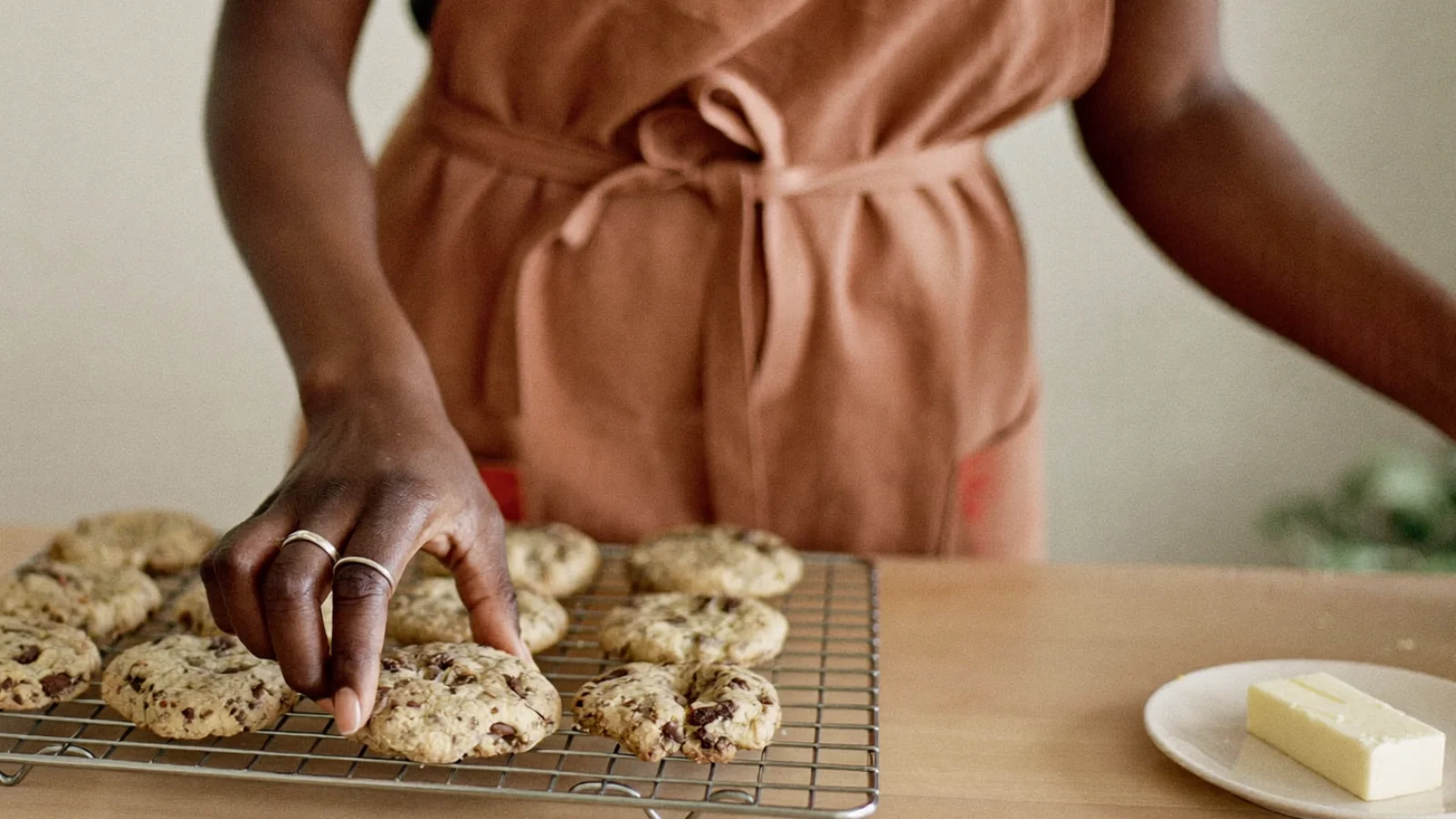
Chocolate chip, peanut butter or oatmeal cookies all work. Replace the butter with cannabutter (or half cannabutter, half regular). Make them small so one cookie is an easy, gentle portion.
3. Gummies
Gummies take a little more care because oil and gelatin don’t love to mix, but they’re very doable:
- Warm 1/2 cup fruit juice in a small pan over low heat.
- Whisk in 3 tablespoons unflavored gelatin (or one small box of flavored gelatin plus 1 tablespoon unflavored) until smooth.
- Whisk in 2 to 3 tablespoons infused coconut oil and 1 teaspoon sunflower or soy lecithin. The lecithin keeps the oil from separating.
- Keep whisking for a few minutes over low heat, then use a dropper to fill silicone molds.
- Refrigerate for 1 to 2 hours until firm, then pop them out.
Store homemade gummies in the fridge. They don’t have preservatives, so they won’t last as long as store-bought ones.
4. Infused oil for savory food
Infused olive oil is great drizzled on pasta, roasted veggies or toast. Just keep the heat low when cooking, since high heat can break down THC.
5. Tinctures
If you’d rather not bake at all, a tincture lets you add a few drops to tea or food. Here’s my guide on weed tinctures and how to make one.
How to Make Edibles Kick In Faster
A few things can help homemade edibles work more quickly and more consistently:
- Eat them with a little food that contains fat. THC is absorbed better with fat.
- Don’t eat them on a completely empty stomach if you’ve found they hit unpredictably that way.
- Try a tincture held under the tongue instead. Some is absorbed there, so it may start sooner than a brownie.
Whatever you do, the rule stays the same: wait before taking more.
Storing Homemade Edibles Safely
This part matters most, mama. Homemade brownies and gummies look exactly like normal treats, and kids and pets can’t tell the difference.
- Label everything clearly, with “THC,” the date, and your best guess at strength.
- Lock it up. A lockbox or locked cabinet is best. Never leave edibles on the counter or in a purse.
- Keep them separate from regular snacks, ideally in a container that looks nothing like the family’s treats.
- Butter and oil: fridge for a few weeks, freezer for longer.
- Baked goods: a few days at room temperature, or freeze individual pieces.
If a child or pet might have eaten an edible, call Poison Help at 1-800-222-1222 right away (or your vet for pets), and call 911 if a child is very drowsy, hard to wake or having trouble breathing.
Common Beginner Mistakes
- Skipping the decarb step
- Cooking at too high a heat, which burns off THC
- Making a batch that’s far too strong
- Not stirring well, so some pieces are much stronger than others
- Eating a second piece because “it’s not working” after 45 minutes
- Forgetting to label, then someone grabs a brownie by mistake
If you or someone else ends up too high, here’s how to come down from a high calmly.
Frequently Asked Questions
How do you make edibles with flower?
Decarb the flower in the oven at about 240°F for 30 to 40 minutes, infuse it into butter or oil on very low heat for 2 to 3 hours, strain it, then use that butter or oil in your recipe.
Do I have to decarb weed before making edibles?
Yes, for THC edibles. Without decarbing, most of the THCA won’t turn into THC, and your edibles will be weak or not work.
How do you make edible gummies at home?
Warm fruit juice, whisk in gelatin, then whisk in infused coconut oil with a little lecithin so it mixes evenly. Fill molds and chill until firm.
How strong are homemade edibles?
It’s hard to know exactly. You can estimate using the flower’s THC % and your number of servings, but homemade edibles are often stronger and less even than people expect. Start with a small piece.
Can you make edibles without butter?
Yes. Coconut oil, olive oil or other fats work well, and coconut oil is especially good for gummies.
How long do homemade edibles last?
Baked goods last a few days at room temperature or a few months frozen. Infused butter keeps for a few weeks in the fridge.
The Bottom Line
Making edibles comes down to two steps: decarb your flower, then infuse it into a fat. After that, any recipe is fair game. Keep batches mild, mix well, label everything, lock it away from little hands, and always start with a small piece and give it time. And on the nights you just don’t feel like baking, there’s no shame in a pre-dosed gummy.
Keep Reading
- How to Make Cannabutter: Easy Step-by-Step Recipe
- How to Make Weed Brownies: Easy, Gentle Recipe
- Weed Tincture: What It Is, How to Use It and How to Make It
- Low-Dose THC Gummies: A Gentle Beginner’s Guide for Moms
This article is for general information only and isn’t medical or legal advice. Cannabis laws vary by state; only make edibles where it’s legal for you to do so. Talk to your doctor before using cannabis or hemp products, especially if you’re pregnant, breastfeeding, or taking medication. Hemp THC products are for adults 21+ and are not intended to diagnose, treat, cure, or prevent any disease. High Society Mama is affiliated with Society’s Plant.